Breath
× Dance
Breath is the primary organizing mechanism of the human body in motion. It determines spatial reach, structural stability, and force quality in every movement a body makes. In professional athletic and dance performance, its mastery is the invisible skill. Breath x Dance makes it visible.
Two audiences
who cannot see
conceals
Most observers feel a difference in trained movement without being able to name its cause. The aliveness, the effortlessness - these have a specific physical infrastructure. None of it is perceptible from the outside without the vocabulary to identify it.
omits
Most practitioners receive extensive instruction on what their bodies should do and almost none on the breath infrastructure that supports it. It remains tacit knowledge: transmitted bodily, without the vocabulary or framework that would make it teachable at scale.
What breath changes:
Space, Structure, Force
These are the complete, non-redundant physical quantities affected by conscious breath use in movement. Breath does not simply enable more range - it reorganizes how the body occupies space, maintains organized control at its limits, and transfers effort from center to extremity.
How much of the three-dimensional kinesphere the body occupies during movement. Breath enables spinal lengthening and joint decompression, directly extending reach across the sagittal (Wheel), frontal (Door), and transverse (Table) planes. A body breathing with its movement takes up measurably more space.
The body's organized capacity to move away from its center of gravity and return with control. Breath creates intra-abdominal pressure that stabilizes the spine - the structural foundation for extreme positions. Without it, extended reach becomes risk rather than range. Breath does not just allow the body to go further. It allows the body to go further and come back.
The efficiency and direction of physical effort through the body. The exhale aligns with peak effort moments: push-off, extension, peak contraction. When breath timing coordinates with movement, force travels cleanly from core to extremity. When it does not, force leaks - competing muscle groups interfere and the same effort produces less output.
A skeletal figure executes a continuous axial phrase across the sagittal, frontal, and transverse planes - shown as fine grid rectangles intersecting the body. The user controls breath state through a toggle or dial. In the breath-active state: the kinesphere ellipsoid expands, plane traces extend further in all three dimensions, and the center-of-mass force vector becomes clean and committed in direction. In the breath-neutral state: the kinesphere contracts, traces stay close to center, and the CoM vector shortens and wavers. The movement path is identical in both states. Only the breath infrastructure - and its spatial, structural, and force consequences - changes.
Some dimensions will use a continuous dial rather than a binary toggle - allowing movement through a spectrum of breath engagement rather than between two states.
Seeing breath's effect on the body's physical quantities is one level of understanding. The second level is timing: knowing not just that breath matters, but when in a movement phrase it initiates, releases, and links one movement to the next. A body with precise breath timing does not simply move with better quality - it moves with a different structure of time.
Breath timing
and phrase capacity
Breath timing is not uniform across a movement phrase. Each movement has a phase when breath most efficiently supports it - an optimal moment of initiation or release. When these moments are hit, force travels cleanly, transitions sustain, and the phrase continues at quality. When they are missed, the phrase degrades: range compresses, transitions become effortful, and duration shortens before the work is done.
A movement phrase, sourced from a solo dance recording and rendered as a tracked skeletal figure via MediaPipe, plays in real time. Breath-cue markers appear on a timeline at the bottom - positioned at the optimal breath moments within the phrase. The user presses and holds the spacebar to match each cue.
When a cue is hit: the center-of-mass force vector extends cleanly, a brief range halo appears at the body's outermost reaching point showing committed spatial extent, and the phrase segment illuminates in the timeline bar. When missed: the CoM vector shortens, no halo appears, and the segment shows a compressed state. At the end of the phrase: a summary shows which segments reached full capacity and which did not.
Prototypes
and artifacts
Two artifacts are in active development. Both are rendered tests - not exhibition-ready work. The documentation below shows where each piece is and what it is reaching toward.
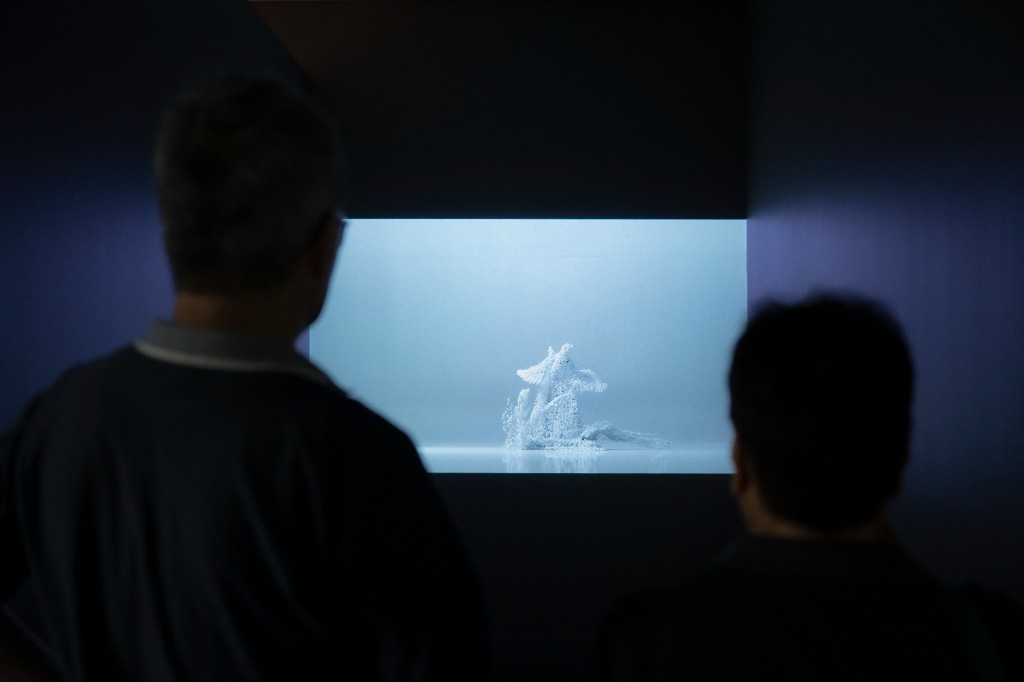
Motion-captured dance solos rendered as particle simulations. Particles emit from the body's geometry and travel on wind turbulence fields - visualizing the somatic imagery the dancer was using: the internal breath instruction, made external. The body has disappeared. What remains is the movement infrastructure.
Assets include particle dance video renders and motion capture comparison documentation: raw mocap data shown alongside the particle transformation.
A CT scan of a human lung - sourced from the RIDER Lung CT Collection, The Cancer Imaging Archive - simulated dissolving into and reforming from particles. The physiological reality of breath and the choreographic imagination of it collapse into the same visual material. Pending final voiceover script and audio timing.
The live version, not yet built: a microphone on the dancer maps breath amplitude to particle emission force and vorticity in real time.
A two-minute video walkthrough of the project as it currently stands - the intent, the method, and the work in progress. Includes a sequence showing the artist developing the interactive viewport for the mesh-captured dancer: a direct indicator that the educational and interactive layers of the piece are actively being built.
Configured
for space
Breath x Dance is designed as a scalable installation system. The work can be configured across three formats depending on available space, budget, and production context. Each delivers the same core argument at a different spatial scale and audience engagement depth.
Breath x Dance is one research thread within Make Dance Comprehensible - a larger project building an exhibition framework to make the invisible architectures of movement legible to non-specialist audiences. The central argument of that project: the most demanding technical and expressive capacities of dance are invisible to untrained observation, and that invisibility is a structural problem for public engagement with the art form. Breath x Dance addresses one layer of it: the breath infrastructure that precedes and drives all visible movement.